For most of the modern aviation era, airlines have had two ways to extend their reach. They grow organically by adding aircraft and launching self-operated routes, or they cooperate commercially through codeshares, interline agreements and joint ventures. Both approaches remain viable and continue to generate substantial value, but the balance between them is shifting as airlines recognise the commercial benefit of technology-enabled partnerships that can create more flexible networks faster and at lower cost.
The Two Paths Airlines Have Always Known
Organic growth gives an airline full control over the customer, the schedule and the economics of a route. It also demands the most capital. New aircraft, new crews, new ground-handling contracts, and new commercial agreements with airports at each end of the route are all resource-intensive investments that can strain an airline's balance sheet and stretch ROI forecasts over years.
Commercial cooperation distributes that risk. Codeshares allow one carrier to sell seats on another's flights under its own code, and interline agreements allow passengers to connect between airlines on a single ticket. Joint ventures pool revenue and coordinate schedules on specific markets. These tools have built much of the connectivity that defines the global aviation industry, and the revenue reflects it: IATA's Clearing House settled $63.8 billion in interline and associated billings between 581 airlines and partners in 2024.
The choice between these paths has always been a function of strategic priorities and balance sheet capacity, not a question of which model is superior in the abstract. It’s typically full-service carriers with strong home markets and easy access to capital that pursue organic network growth. Airlines extending into markets that might not be feasible to operate in directly often choose interline or partnership strategies. Most carriers use both.
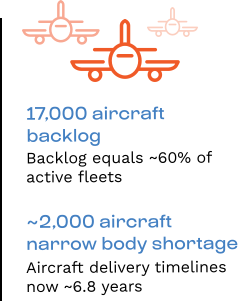
The X factor is the operating environment. The pressure the industry faces in 2026 has raised the cost of organic expansion while concurrently exposing the limits of legacy partnership models. Order backlogs now stand at 17,000 aircraft, equivalent to almost 60% of the active fleet, against a historical average of 30% to 40%. Airlines that planned their networks around aircraft they expected to receive in 2026 are rethinking those plans for 2028 and beyond.
Cost Pressure, Supply Constraints and the Limits of Independent Growth
Aircraft availability has also tightened from a short-term irritation into a structural constraint. McKinsey estimates the global narrow-body shortage at roughly 2,000 aircraft factoring in delayed retirements. An aircraft ordered today will take roughly 6.8 years to be delivered compared with the four-year cycle the industry planned around for most of the last decade. Lease rates have climbed. Airframes that should have left the fleets two years ago are still flying, raising fuel costs across route networks.
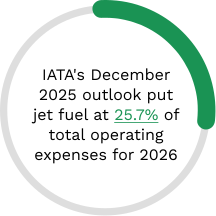
And of course, fuel is already airlines’ single largest operating cost. IATA's December 2025 outlook put jet fuel at 25.7% of total operating expenses for 2026, assuming a relatively stable crude price, even as geopolitical disruptions have made it anything but. The conflict in the Gulf and the interruption of supply routes across the wider Middle East have already pushed fuel costs well beyond the baseline forecast.
Demand carries its own uncertainty. IATA expects 5.2 billion passengers in 2026 and a record load factor of 83.8%, but the regional spread is uneven, premium leisure is reshaping yield profiles, and corporate travel hasn’t settled into a stable pattern. Airlines launching routes based on 2024 demand assumptions may confront a very different market by the time those flights begin operating.
Together, these forces make organic route expansion a riskier and more costly proposition today. The airline commits capital up front, waits years for the aircraft, then asks the route to perform against a demand picture that may have moved dramatically. Network planners are now looking for ways to reduce that exposure without sacrificing growth.
The Limitations of Legacy Partnership Models
Codeshare and interline agreements offer one obvious alternative. They have served the industry for decades and continue to generate substantial revenue across IATA’s Clearing House (ICH) and other settlement systems. But the structure of these agreements significantly limits how quickly an airline can use them to enter a new market.
Entering a codeshare alliance or cementing a traditional bilateral agreement typically requires working through commercial terms, IT scoping and regulatory filings over many months, sometimes years of complex cross-border arrangements. The integration work that follows is equally cumbersome: synchronising schedules, aligning fare classes, linking reservation systems and updating distribution channels all represent a significant legal, commercial and technical expense.

Once a codeshare is in place, it’s difficult to unwind quietly. Carriers tend to commit to partners they expect to work with for years, which makes the model poorly suited to market testing. An airline that wants to probe demand on a single origin-destination pair before scaling can’t do so through codeshare without taking on commitments that outlast the test.
Low-cost carriers have typically stayed away from these structures because they don’t match their operating models. LCCs that run on point-to-point economics, ancillary revenue and lean ground operations can’t absorb that cost structure without abandoning the model that makes them competitive. So alliances remain a partnership framework that works well for established cooperation among full-service carriers, but serve a much narrower role for other industry stakeholders.
Connected Travel is a Faster, More Responsive Growth Tool
Connected travel fills the gap between organic growth and legacy partnerships. The model combines flights from separate carriers into a single bookable itinerary, with structured disruption handling and clear passenger protection, without requiring a formal codeshare or interline contract between the airlines involved. The connection is facilitated by a technology platform rather than a bilateral agreement, which provides four distinct operational advantages:
#1 Speed of execution. Airlines can test a route in weeks instead of spending months or years launching it through codeshare. The carrier identifies a partner, validates the connection logic on the platform and starts selling. Worldwide by easyJet, the platform powered by Dohop, now offers more than 5,000 unique origin-destination combinations through 20+ airline partners. Each of those combinations represents an expansion of reach that the airline did not have to fund through fleet growth or negotiate through codeshare.
#2 No fleet commitment. Connected travel extends an airline's network without ordering aircraft, hiring crews or opening new stations. The partner carrier flies the incremental segment. The selling carrier captures the customer relationship, the booking and the data without incurring the operating costs of the additional flight. Scoot saw the scale of that opportunity at launch: the carrier added 30 new destinations on the day it went live with its Dohop-powered connected travel platform, opening routes across Europe through partner carriers without committing a single additional aircraft of its own.
#3 Risk-managed market testing. Airlines can launch, monitor and adjust connected routes without unwinding a long-term agreement. If demand on a Budapest-to-Abu Dhabi connection proves softer than expected, the airline has the flexibility to modify or remove the offering. If it proves strong, the airline scales by adding frequencies or layering in additional partners on the same corridor.
#4 Passenger protection through the platform. The connection handling, baggage policy and disruption recovery are coordinated by the technology provider rather than dictated by a chain of bilateral contracts. Passengers see a single itinerary with clear terms. When a single flight disruption causes a missed connection, the platform activates its protection mechanism rather than leaving passengers to navigate separate claims with each airline involved.
The combination of these four advantages turns connected travel into something more than a workaround for airlines that can’t codeshare. It becomes their primary tool for entering markets where the economics of organic growth are questionable and the time cost of codeshare is prohibitive.
Partnerships as an Adaptable First-Order Approach to Network Strategy
Let’s be clear: airlines aren’t abandoning fleet growth or alliance membership. Both still matter, and both will be needed to meet the demand growth IATA forecasts through the rest of this decade. The 83.8% load factor projected for 2026 leaves little headroom on existing networks, and carriers that want a share of the additional 5.2 billion passengers expected to fly this year will need every channel they can credibly operate.
“A route that would take months or years to launch through codeshare can be tested in weeks through the connected travel model.”
The shift is in how carriers assess their options. Partnerships are moving from a secondary tool to a primary one, with capital-intensive expansion reserved for routes where the economics support a multi-year commitment. Network planners are starting to treat route-level decisions as a spectrum, with self-operation at one end and deep alliance integration at the other. In between, there are connected travel partnerships, technology-led commercial arrangements and hybrid models that combine elements of each.
Carriers that embrace the spectrum approach to network growth have a flexibility advantage when conditions change. They can test origin-destination combinations and enter new markets faster and reap the benefits of multi-carrier journeys without taking on the cost structure of legacy interline.
The innovative global airlines with Dohop-powered connected travel platforms – including easyJet, Wizz Air and French Bee, among many, many others – show how this approach delivers real commercial results. Having a flexible, efficient way to grow their networks outside the traditional interline framework allows these airlines to scale with demand.

To learn more about how Dohop supports connected travel partnerships that help airlines grow networks more flexibly, test new markets faster and create integrated multi-carrier journeys, get in touch with us here.